The Enduring Utility of the Lined Notebook in a Digital World
In an era dominated by screens, notifications, and cloud-based everything, the lined notebook endures as a remarkably resilient tool. It sits quietly on desks, slips into bags, and fills shelves in homes and offices worldwide. This is not mere nostalgia. The lined journal offers a tactile, focused, and deeply personal experience that digital tools struggle to replicate. Whether you are a professional sketching out a business model, a student grappling with complex concepts, or a hobbyist recording observations, the humble ruled page provides a framework for clarity. Understanding why this format persists, and how to leverage it effectively, reveals much about how we think, plan, and create.
The Cognitive Advantage of Writing by Hand
The act of writing on a lined notebook page engages the brain differently than typing. Neuroscientific research consistently shows that the slower, deliberate process of handwriting activates neural circuits involved in memory encoding and conceptual understanding. When you write in a lined journal, you are not simply transcribing thoughts; you are forging a deeper connection with the material. The physicality of pen on paper requires you to summarize, rephrase, and organize ideas in real time. This process filters noise and prioritizes what truly matters. For a researcher synthesizing dense literature or a business owner mapping out a quarterly strategy, this cognitive friction becomes an advantage. It forces deeper processing. The ruled lines provide a subtle grid for structure, but the act of writing itself demands active engagement. This is why many educators and creative professionals still reach for a lined notebook when they need to truly understand a problem, rather than just document it.
From Brain Dump to Structured Thought
One of the most powerful uses of a lined journal is as a processing tool. Before a single line of code is written or a budget is finalized, the messy, non-linear nature of human thinking needs a space to land. A lined notebook offers that sanctuary. Professionals across industries use a technique often called a "brain dump" or "morning pages," capturing every stray thought without judgment. The lines keep the chaos contained, providing a visual anchor. Over subsequent pages, these raw fragments can be reviewed, categorized, and transformed into actionable plans. The lined notebook thus serves as a bridge between the abstract and the concrete. A marketing executive might brainstorm campaign ideas on one page, then use a facing page to outline execution steps. The physical act of flipping back and forth between notes builds a spatial memory of the information, something a scrolling screen cannot provide.
Practical Applications Across Diverse Fields
The versatility of the lined journal becomes apparent when you observe its use across different domains. It is not a one-size-fits-all tool in the generic sense; rather, its simplicity allows it to be adapted to countless workflows.
- For Educators and Researchers: The lined notebook is indispensable for field notes, lecture preparation, and literature reviews. The ability to sketch diagrams, write equations, and annotate margins fluidly makes it superior to most digital note-taking apps for complex, visual thinking. A biologist recording observations in the field relies on the durability and immediacy of a bound journal.
- For Creatives and Hobbyists: Writers, artists, and musicians use the lined journal as a sketchbook for language and ideas. A poet might capture a fleeting phrase on a ruled line, while a designer sketches layout ideas alongside written notes. The consistency of the lines helps maintain proportion in handwriting and basic sketches alike.
- For Business Owners and Professionals: Meeting notes, project roadmaps, and client call logs find a natural home in a lined notebook. It eliminates the distraction of digital devices during meetings. The act of writing notes by hand has also been shown to improve listening comprehension and retention, a critical advantage in negotiations and strategy sessions.
- For Everyday Life and Productivity: Bullet journaling, habit tracking, and gratitude journaling have popularized the lined journal as a tool for personal organization and well-being. The structure of lines allows for clean lists, tables, and calendars without needing a pre-printed layout.
Why Line Spacing Matters More Than You Think
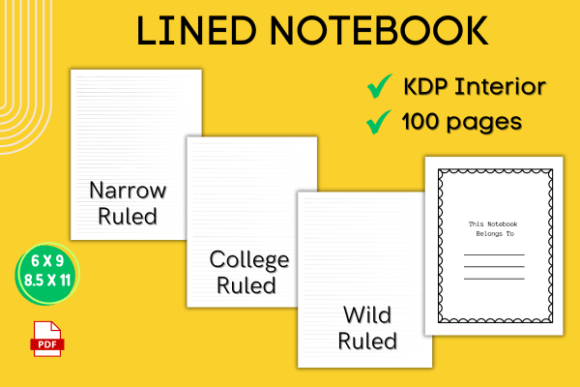
Not all lined notebooks are created equal. The width between lines, commonly referred to as ruling, directly affects the user experience. Narrow ruling is ideal for small handwriting or dense information like technical notes and foreign language study. Wide ruling suits younger writers or those with larger, looser handwriting. Medium or college-ruled paper is the standard for most professional and academic work. Choosing the right spacing in your lined journal can reduce eye strain and improve the legibility of your notes. A professional who writes quickly in meetings may benefit from wider lines to accommodate fast, sprawling script, while a researcher compiling citations may prefer narrow lines to conserve pages. This seemingly minor detail greatly influences how effectively the notebook serves its purpose.
Material Considerations and the User Experience
The feel of a lined notebook is defined by its physical components. The paper weight, or GSM (grams per square meter), determines whether ink bleeds through to the next page. For those using fountain pens or heavy markers, a higher GSM paper is essential. The binding—whether spiral, stitched, or glued—determines how flat the notebook lies when open. A stitched binding that opens completely flat is preferred by many for comfortable writing across the entire spread. The cover material adds durability and a tactile quality that influences how often you reach for the notebook. A softcover lined journal is easily bent and slipped into a pocket, while a hardcover version offers a firm writing surface and better protection. These material choices transform a simple stack of lined paper into a trusted daily companion. A hobbyist sketching on the train might prefer a pocket-sized spiral notebook, while a business executive keeping a formal log may choose a leather-bound, stitched lined journal.
The Role of Portability and Consistency
One of the overlooked advantages of the lined notebook is its independence from batteries, Wi-Fi, and logins. It is always ready. This reliability is a major factor in its continued use by professionals who travel, work in remote locations, or simply face screen fatigue. The consistent format of a lined journal also creates a reliable container for your thinking. Knowing every page has the same structure reduces cognitive overhead. You do not need to format, save, or organize files. Context switching is minimized. This consistency allows for a deeper state of flow, particularly valuable for creators and problem-solvers. The act of opening a familiar lined notebook can itself become a psychological cue that signals the brain to focus.
Navigating the Analog-Digital Workflow
The most effective use of a lined journal today is not as a replacement for digital tools, but as a complement to them. Many professionals have developed hybrid workflows that leverage the strengths of both. Ideas are captured and developed in a lined notebook, where the thinking is raw and unconstrained. The refined outputs are then digitized—photographed, scanned, or transcribed—into project management tools, cloud documents, or reference databases. This approach combines the cognitive benefits of handwriting with the searchability and accessibility of digital storage. A researcher might sketch a complex methodology on paper, snap a photo with their phone, and tag it in a research management app. The lined journal becomes the incubator, and the digital system becomes the archive. This pragmatic synthesis acknowledges that no single tool is perfect for every stage of the thinking process.
Building a Personal System That Lasts
The true value of a lined journal accumulates over time. A single notebook captures a slice of your life, work, or learning. A shelf of them becomes a personal library of your intellectual journey. Many professionals find immense value in reviewing old lined notebooks to track the evolution of an idea, revisit past solutions, or recognize patterns in their own thinking. This longitudinal perspective is difficult to achieve with digital notes that are easily deleted, archived, or forgotten. The physical presence of a completed lined journal offers a tangible sense of progress and accomplishment. It is a record of effort, not just outcomes. For a hobbyist tracking a garden's growth over seasons, or a business owner chronicling a startup's early years, these notebooks become irreplaceable documents.
The lined notebook and lined journal remain relevant not because they are retro or romantic, but because they are functionally superior for certain types of thinking. They slow us down to speed us up, providing a structured space for unstructured thought. By understanding the cognitive science behind handwriting, choosing the right physical features for your needs, and integrating the notebook into a broader workflow, you unlock a tool that has served thinkers for centuries and will continue to do so for many more. It is a technology that is perfectly suited to the messy, beautiful process of human cognition. Whether you are sketching a business plan, writing a poem, or simply trying to make sense of a complicated week, the ruled page awaits, ready to help you think.