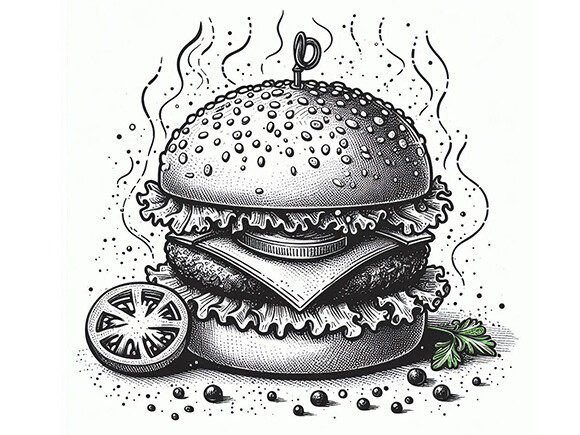
The Significance of a Drawing of a Hamburger in Visual Communication
When someone mentions a drawing of a hamburger, the image that springs to mind is often deceptively simple: a bun, a patty, a leaf of lettuce, perhaps a slice of cheese. Yet this seemingly mundane subject holds a remarkable depth when examined as a tool for communication, education, and creative expression. The humble hamburger drawing is not merely a sketch—it is a universal symbol that bridges cultures, invokes appetite, and serves as a practical case study for artists, marketers, educators, and entrepreneurs alike.
Why the Hamburger? A Universal Visual Cue
Few food items are as globally recognized as the hamburger. Even in regions where it is not a dietary staple, the visual concept of a burger—round bun, layered fillings—is immediately identifiable. A drawing of a hamburger taps into this shared understanding. Unlike abstract shapes or niche subjects, the hamburger carries no steep cultural learning curve. This makes it a powerful vehicle for teaching fundamental drawing principles, testing brand concepts, or conveying ideas in user interface design (hence the “hamburger menu” icon, though that is a separate evolution). The drawing becomes a shorthand for approachability, comfort, and a certain casual efficiency.
From a marketing perspective, a simple line drawing of a hamburger can be more effective than a high-resolution photograph in certain contexts. A sketch suggests authenticity, handcrafted quality, and a personal touch. Many fast‑casual restaurants use chalkboard-style burger drawings on their walls to evoke a friendly, handmade vibe. This interplay between simplicity and recognition is what makes the subject so valuable.
Applications Across Diverse Fields
The utility of a drawing of a hamburger extends far beyond the restaurant menu. Let’s examine several real-world applications where this image plays a key role.
Art Education and Foundational Skills
Art instructors frequently choose a hamburger as a subject for beginning drawing students. Why? Because it contains multiple shapes (circles, ovals, irregular blobs), varied textures (smooth bun, rough lettuce, glossy cheese), and layered composition. A student learning to represent a drawing of a hamburger practices proportion, shading, and perspective in a low-stakes, relatable context. It is forgiving—unlike a portrait, a slightly asymmetrical burger still looks like a burger. Moreover, the hamburger teaches value gradation: the toasted bun requires light and shadow, the patty demands darker tones, and the vegetables introduce subtle highlights.
- Shape recognition: Identifying basic forms within complex objects.
- Texture rendering: Using hatching or stippling for a sesame seed bun.
- Composition: Arranging layers to create depth and visual interest.
Hobbyists and educators alike report that students engage more enthusiastically with food subjects than with still‑life classics like vases or fruit. A hamburger feels contemporary and accessible.
Brand Identity and Menu Design
Burger chains and independent eateries often rely on a drawing of a hamburger to communicate their core offering without clutter. A stylized illustration can become a brand’s visual anchor, appearing on signage, packaging, and digital platforms. The advantages are clear:
- Scalability: A simple line drawing works at billboard size and on a mobile app icon.
- Timelessness: Unlike photography, which may date or require updates, a well-crafted drawing retains a consistent personality.
- Emotional resonance: Hand-drawn imagery suggests care and tradition, appealing to consumers seeking authentic experiences.
Consider the iconic “Sonic the Hedgehog” hamburger posters of the 1990s: the exaggerated, cartoon-style burger drawings were instantly recognizable and built a fun brand persona. Even today, many craft burger shops commission local artists to create original burger drawings for menus, fostering community connection.
User Interface and Iconography
The digital world has adopted the hamburger icon as a navigation standard, but the visual metaphor remains potent. When an app or website uses a drawing of a hamburger as an icon, it leverages the same immediate familiarity. However, the subject also appears in other UI elements: empty states, loading screens, and illustration kits. A simple burger drawing can convey “food” or “menu” without relying on text, making interfaces more intuitive for global users. This crossover from art to UX demonstrates the drawing’s versatility.
Educational Tools for Nutrition and Industry
In health education and culinary training, drawings of hamburgers serve as neutral teaching aids. Nutritionists use simple burger diagrams to discuss portion sizes, calorie density, and balanced meals without the influence of a brand photograph. Culinary schools ask students to create a detailed drawing of a hamburger as an exercise in understanding ingredient layers, cooking techniques (the difference between a charred patty and a steamed one), and presentation. The drawing becomes a bridge between theory and practice.
Business owners, from food truck operators to meal kit companies, frequently use burger drawings in pitch decks and prototypes to communicate a product concept before investing in actual photography or production. It is a low-cost, high-clarity tool for iteration.
Characteristics That Make a Drawing of a Hamburger Effective
Not all hamburger drawings are created equal. The effectiveness of such an image depends on several characteristics, whether it is used for art, marketing, or education.
Level of Detail and Abstraction
A hyper-realistic drawing of a hamburger can be astonishing—every sesame seed, every drip of ketchup. At the other extreme, a minimalist outline with just a bun, patty, and lettuce can be equally powerful for a logo or icon. The key is matching the detail level to the context. A menu for a high-end gourmet burger brand might benefit from a detailed cross-section showing every ingredient, while a kids’ meal package might use a playful, exaggerated cartoon.
Observations from design agencies show that a drawing of a hamburger with moderate detail—enough to identify the components but simple enough to be reproduced consistently—often performs best in branding. The “goldilocks” zone balances personality with scalability.
Emotional Tone
The line quality and color palette of a burger drawing convey emotion. Rough, energetic strokes imply casual fun; clean, precise lines suggest professionalism. Warm browns, yellows, and greens evoke comfort and appetite, while monochrome sketches can feel artistic and nostalgic. An educational illustration might use a neutral tone to focus on structure, while a children’s book uses bright, saturated colors. The versatility of the subject allows it to adapt to virtually any mood.
Cultural and Dietary Considerations
An inclusive drawing of a hamburger may depict plant-based patties, gluten-free buns, or non-standard toppings. As consumer preferences diversify, creators and businesses benefit from representing these variations. A vegan burger drawing still communicates the same structural idea—layered bun and filling—but appeals to a broader audience. This flexibility is an advantage over photographic representations, which can be more labor-intensive to update.
Real-World Examples and Use Cases
Let’s explore how different stakeholders use a drawing of a hamburger in practice.
Educators in Action
Ms. Rivera, a middle school art teacher, begins her still-life unit with a drawing of a hamburger. She projects several reference images ranging from fast-food ads to children’s drawings. Students sketch their own versions, first focusing on rough shapes, then adding details. She notices that students who struggle with conventional still lifes bloom when drawing food. One student creates a burger with a sesame seed bun using pointillism; another uses cross-hatching to show texture. The assignment builds confidence and foundational skills that students later apply to more complex subjects.
Marketing Professionals
A small burger chain, “The Lucky Patty,” wanted to refresh its brand without a costly photoshoot. They hired a local illustrator to create a series of burger drawings for their website, social media, and physical menu boards. The drawings were slightly imperfect—a skewed tomato slice, a bun that wasn’t perfectly round—which gave the brand a human, approachable feel. Sales increased, and customer feedback praised the “artistic” look. The owner noted that the drawings sparked conversations about local art, further building community.
UX Designers
An app developer for a food‑ordering platform needed an icon for the “favorites” section. Instead of a generic star, they used a stylized drawing of a hamburger to represent “your go‑to order.” User testing showed that the burger icon was instantly recognized and tapped more frequently than the star, because it directly related to the food context. The drawing was simple—just five lines and a solid fill—yet outperformed more conventional icons.
Advantages of Using a Drawing Over Photography
While photography has its place, a drawing of a hamburger offers distinct advantages in several scenarios:
- Cost efficiency: Creating a custom drawing is often cheaper than organizing a professional food photoshoot.
- Flexibility for revision: Changing a detail in a drawing (e.g., adding a new topping) is faster and less expensive than reshooting.
- Consistency across materials: A drawing can be used on a menu, a website, and a t‑shirt without looking mismatched.
- Emotional connection: Hand-drawn elements are perceived as more authentic and personalized.
- Brand differentiation: In a sea of glossy photos, a distinctive drawing stands out and is memorable.
Of course, photography excels at realism and appetite appeal, but for long-term identity and communication of concepts, a drawing often wins.
Considerations When Commissioning or Creating a Drawing of a Hamburger
Whether you are an artist, educator, or business owner, there are factors to weigh before investing time or resources into a hamburger drawing.
Purpose and Audience
Define the primary function. Is it to teach a skill? To sell a product? To decorate a space? The audience’s expectations matter. A realist drawing for an art competition demands different skills than a cartoonish drawing for a children’s app. If your target audience is children, bright colors and exaggerated features (e.g., big eyes on the burger) may resonate. For a professional culinary publication, anatomical accuracy of ingredients is crucial.
Medium and Style
Digital drawings offer easy editing and distribution; traditional media (pencil, ink, watercolor) provide unique textures that can enhance perceived value. Consider where the drawing will live: a digital menu on a screen may benefit from a clean vector style, while a printed poster might look better with a rough painted edge. The style should align with the brand’s or project’s personality.
Inclusivity and Representation
As mentioned, showcasing a range of dietary options in a drawing—vegan patty, gluten-free bun, varied toppings—signals inclusivity and awareness. This is particularly important for businesses and educators aiming to reach diverse groups. A drawing of a hamburger that only represents a classic beef patty might alienate potential customers or students with different diets.
Legal and Intellectual Property
If a drawing closely mimics a specific chain’s burger (e.g., McDonald’s Big Mac with its signature sesame seed bun and two patties), it could infringe on trademark or trade dress. For commercial use, ensure the drawing is distinct or sufficiently generic. Original interpretations are safer and often more creative.
Future Trends and Observations
The role of a drawing of a hamburger continues to evolve. With the rise of AI-generated imagery, simple hand-drawn burgers are gaining a premium as “human made” artifacts. Augmented reality filters that let users “draw” a burger in 3D space are emerging in education and entertainment. Food illustrators are increasingly collaborating with restaurants for limited-edition merchandise. The hamburger drawing remains a vibrant intersection of art, commerce, and everyday life.
For hobbyists, the joy of sketching a burger lies in its immediate accessibility—you don’t need expensive materials or years of training. A napkin and a pen can produce a satisfying image. For professionals, it is a strategic asset that communicates trust, warmth, and clarity. The next time you encounter a drawing of a hamburger, consider the layers of intent and craft behind it. From a child’s first doodle to a global brand’s logo, that simple sketch holds a remarkable amount of meaning.
In summary, whether you are an educator looking for a teaching tool, a marketer seeking authentic visuals, or a creator exploring your own style, a drawing of a hamburger offers a practical, universally understood foundation. It is a subject that rewards both the novice and the expert, and its applications are as varied as the artists who pick up a pencil to capture it.